
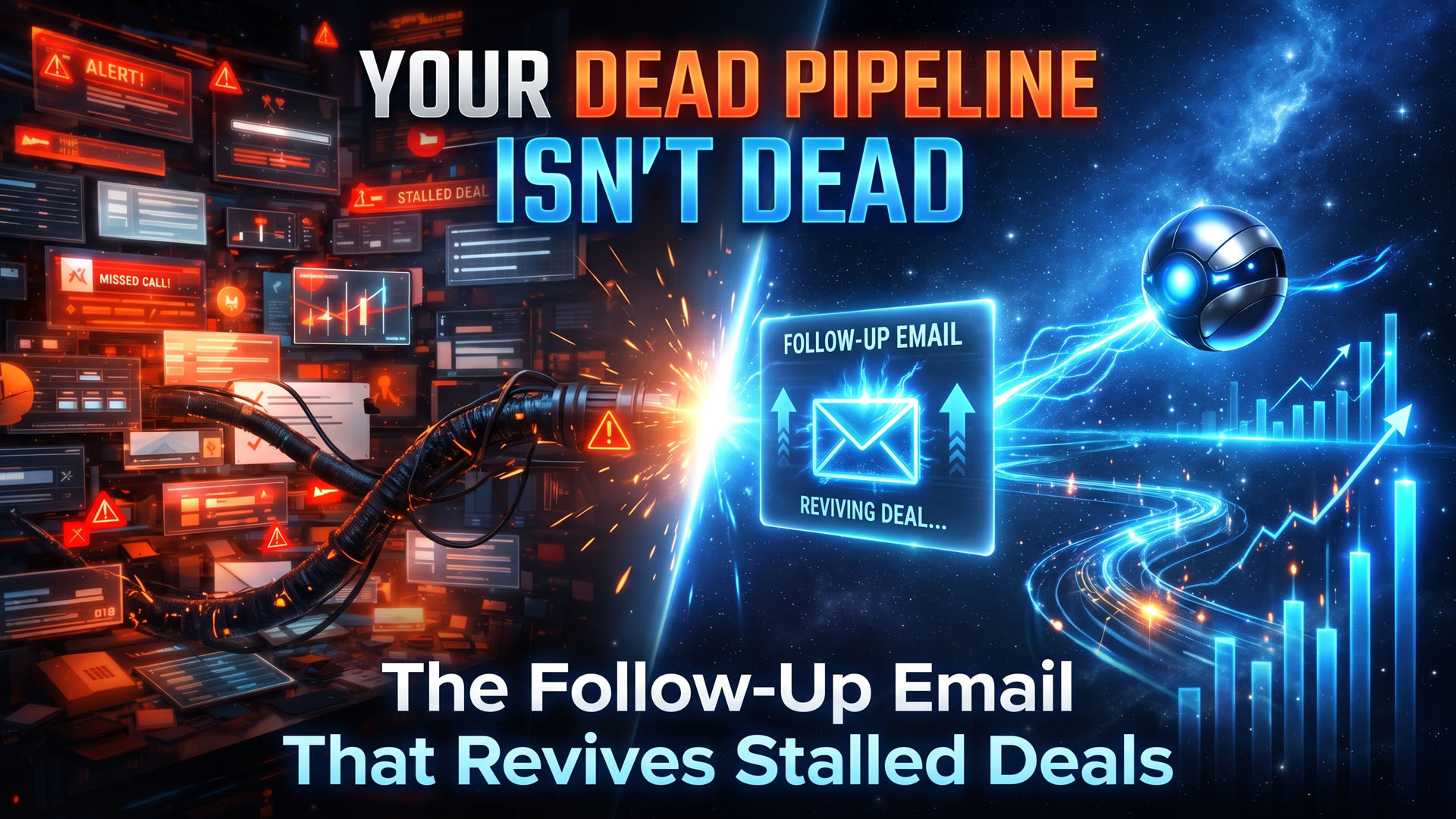
The fastest way to revive stalled deals is to stop treating them as lost and start treating them as interrupted. Most of the deals sitting quietly in your CRM never ended with a no. They ended with a prospect who got busy, and a seller who had nothing new to say. The right follow-up email after no response gives that buyer something new to say yes to.
Anatolii Lavryk made this case recently in a sharp Medium piece called Your Dead Pipeline Isn't Dead. His argument is that early-stage teams reach for new channels and new tools when the faster pipeline is already in the CRM, in past calls, and in the founder's own network. He lays out three moves that each take under thirty minutes and need no budget.
We agree with every one of them. We also think the advice reveals a problem worth naming. Good habits that depend on a founder remembering to do them tend to quietly stop. At Ask Ledo, we build around a simple idea we call the Calm Operator: the system should carry the rhythm so the person can carry the conversation. Here is how his playbook works, and how an AI CRM can make it run without adding one more thing to your morning.
What is a stalled deal, and why do deals go quiet?
A stalled deal is an opportunity that had real momentum, never received an explicit no, and has not moved forward for 30 days or more. That definition matters because it separates a stalled deal from a lost one, and from a cold lead that never had a real conversation with you at all.
Deals usually go quiet because something else became more urgent for the buyer. A reorganization, a quarter close, a new manager, or a competing project pushed your conversation down their list. The problem you discussed did not go away. It simply stopped being the first thing they thought about each morning.
That is encouraging news for any sales team. A deal that stalled because of timing can often be restarted with one relevant message, as long as that message gives the buyer a reason to care again today. The harder part is noticing the stall before the deal has been quiet for so long that the buyer no longer remembers you.
Which stalled deals are worth reopening?
A stalled deal is worth reopening when it meets four conditions. Lavryk recommends filtering your CRM for exactly these, and we think the list is right.
- There was a real conversation. At least one proper call happened, not just a reply to a cold email.
- The account still fits your ideal customer profile. Your ICP has probably sharpened since that call, so leave out anyone who no longer fits.
- The buyer never said no. A clear no deserves respect. Silence is a different thing.
- The deal has not moved in 30 days or more. That is long enough to count as stalled and recent enough that they still remember you.
If the filter returns more than ten deals, keep the ten with the largest potential value or the strongest pain from the original call. Ten thoughtful messages will outperform forty rushed ones.
How an AI CRM finds these deals for you
Most of the data behind this filter already lives in a CRM, and LeadMachine uses it continuously instead of waiting for someone to run a report. Every lead carries an A to D grade built from five weighted dimensions. Engagement accounts for 30 percent of the grade and recency for 25 percent, so a deal that goes quiet loses ground on exactly the factors that signal a stall.
The remaining dimensions cover the rest of the filter. Enrichment from Hunter.io, Apollo.io, Google Places and Exa keeps company data current, which tells you whether an account still fits your ICP and protects you from the stale CRM records that make most pipeline reviews unreliable. Value signals such as open deal value and past orders help decide which ten deserve attention first. Deal Flow tracks how long each opportunity has sat in its stage.
One condition still needs a human. A buyer's explicit no usually lives in call notes rather than structured fields. When a prospect declines clearly, record it on the deal so it never resurfaces as a suggestion. Respecting a no is part of working calmly, not an exception to it.
How do you write a follow-up email after no response?
A follow-up email after no response that revives a stalled deal has three parts and nothing else: one fresh observation, one callback to what the buyer told you, and one question. This is the core of Lavryk's playbook, and it works because every part does a specific job.
- A fresh observation. Mention something new and specific about the buyer, such as a job posting, a funding round, a product launch or a new executive. It proves you are paying attention and gives the message a reason to exist today.
- A callback to their own words. Reference the problem or goal they described on your last call. This connects the new development to an old pain and shows that you listened.
- One easy question. Ask something they can answer from their phone in ten seconds. A meeting request, a calendar link or three stacked questions all ask for more effort than a quiet buyer is ready to give.
Silence after one email is not an answer, and the data backs that up. Belkins analyzed more than 7.5 million B2B emails sent in 2025 and found that follow-ups produced 58.6 percent of all replies. The third email in a sequence booked 35.6 percent of email-sourced meetings, more than the first two combined. The same study found returns fall off quickly after the fifth step, which is why a good follow-up earns its place with something new rather than simply showing up again.
A sample follow-up email after no response
Here is the formula as a template. Every bracket should be filled with something true and specific to the buyer. If you cannot fill the first bracket with a real development, wait until you can.
Subject: [Company] and the [new development]
Hi [First name],
I saw that [Company] just [fresh observation, such as opened a second location or hired a head of sales].
When we spoke in [month], you said [the problem in their own words]. I would guess the [new development] makes that more pressing, not less.
Is [the problem] still on your list this quarter?
[Your name]
That is four short lines. The buyer can read it in the time it takes to unlock a phone, and the question can be answered with one word.
Why "just checking in" kills deals
A "just checking in" email tells the buyer you have nothing new to share. It also hands them the work of remembering who you are and why you spoke. That is noise moved from your desk to theirs, and busy people ignore it for good reason. Gartner research finds that 75 percent of B2B buyers prefer a rep-free sales experience. A message that asks for their time without giving them anything confirms why.
We think of the three-part message as calm communication pointed outward. It does the thinking before it reaches the buyer, which is the same standard we hold our own software to. We made a similar argument about the moment right after a lead arrives in Gary Vee's Marketing Formula Works. Your Follow-Up Is Why It Doesn't.
Where the raw material already lives
Each part of the message depends on information most teams already have but rarely have in one place. LeadMachine's enrichment waterfall keeps company records current, which is where fresh triggers tend to appear. Meeting briefs and deal notes hold the buyer's original pain in their own words. Ledo brings those pieces together on the deal record so the person writing the message starts with context instead of a blank screen.
The final send stays with a person. That is deliberate, and it is where we draw the line between automation and authenticity. The same principle runs through AdMachine, our managed advertising service, where a human approves every change before it goes live. A reopen message carries your name and your relationship, so it should leave your hands only when you have read it.
Where else is warm pipeline hiding?
Beyond stalled deals, warm pipeline usually hides in two places: the end of your sales calls and your own network. Both convert better than cold leads because the buyer already has a reason to trust you.
Ask for an introduction on every good call
Most calls end with a polite goodbye, which leaves a referral on the table. Lavryk suggests reviewing a prospect's connections before the call and picking three to five who fit your ICP. At the end, ask which other companies are dealing with the same problem, then name a specific person you noticed. If they agree, write the introduction for them so forwarding it takes no effort.
Ledo already prepares meeting briefs before calls, and that brief is the natural home for this ask. A single line reminding you to request an introduction, alongside the context you need for the conversation, turns a good habit into a default.
Scan your network against your ICP
Lavryk's second suggestion is to export your LinkedIn connections and have an AI assistant match them against your ICP, explaining why each person fits and whether there is a reason to reach out now. That is the same job LeadMachine performs on every incoming lead. Ledo researches the contact, grades the fit from A to D, and shows the reasoning behind the grade so you can disagree with it when it is wrong. Most founders who run this exercise find people they had forgotten about who fit better than half their cold list. If you want more places to look before buying new leads, How to Get More Leads covers the four levers most teams already paid for.
How do you make reopening stalled deals a habit instead of a campaign?
The most reliable way to keep reviving stalled deals is to let your system run the rhythm rather than your calendar. Lavryk closes his piece by recommending a steady cadence: reopen ten deals a month, ask for an introduction on every good call, and rescan your network each quarter. That advice is correct. It is also the part most founders abandon by the second month, because a monthly ritual competes with every urgent task that lands on the same afternoon.
This is the problem the Calm Operator philosophy was written to solve, and it is the gap in most sales pipeline management advice. Jay Thornton, founder of Ask Ledo, describes a Calm Operator as someone who is decisive because the system around them does the heavy lifting. Good intentions should not require constant willpower. He expands on the idea in Calm Intelligence Is Not a Feature.
Why the wrong automation makes things worse
The obvious way to automate this is also the wrong way. A badge announcing 47 stale deals, or a weekly digest of everything that went quiet, simply moves the noise somewhere new. It creates a list that feels urgent and gets ignored, which is how most of those deals went quiet in the first place. We have written before about why a CRM that shows you everything is the problem, not the solution.
What calm automation looks like in practice
LeadMachine spreads the work out instead of piling it up. Focus Mode shows one prioritized action at a time, with the person, the reason it matters, and the next step. Ledo Says delivers three specific suggestions each morning based on real pipeline activity, and you can turn any one into a task with a single click. When you dismiss a suggestion, Ledo learns from it and stops offering it.
In practice, that turns a monthly batch of ten reopen messages into one well-timed deal surfaced on the day it makes the most sense, with its context already attached. If you are in a truck between jobs, you can text Ledo to move the deal or create the follow-up task without opening an app. The rhythm keeps running whether or not you remembered to schedule it. For the full picture of what Ledo handles, see What Can Ledo Do For You?
Does this work outside a traditional sales pipeline?
Yes. The same pattern applies to quiet customers, legacy CRMs, and any business where valuable relationships drift out of view.
Ecommerce customers. For Shopify stores, LeadMachine runs nightly RFM scoring, which ranks customers by recency, frequency and monetary value, and places every customer in a segment, including At Risk and Lost. An AI briefing engine then surfaces re-engagement opportunities as insight cards. A lapsed buyer is a stalled deal by another name, and the same calm approach applies. Shopify CRM: Turn Store Data Into a Sales Engine goes deeper on this.
Teams that already use HubSpot. You should not need to migrate to work the history you already have. Through our HubSpot integration, currently in limited beta, Ledo enriches the contacts you already own while HubSpot stays your system of record. Years of quiet opportunities can get attention without a switch.
Beyond sales altogether. This is the direction of Ledo Everywhere, the next phase for Ask Ledo. The idea is that intelligence should come to where your data already lives, find the signal in it, and surface one clear next action. Stalled investor conversations, dormant partner relationships and lapsed service customers all follow the same shape as a stalled deal. That is what we mean by an AI-native CRM.
Key takeaways
- Most stalled deals never said no. Something else became more urgent for the buyer.
- Reopen a deal only when there was a real conversation, the account still fits your ICP, the buyer never declined, and the deal has been quiet for at least 30 days.
- Every follow-up email after no response needs one fresh observation, one callback to the buyer's own words, and one easy question.
- Follow-ups produce most replies, but returns drop after about five touches. Each one should bring something new.
- Ask for an introduction on every good call, and write the introduction for them.
- The habit lasts when the system carries the rhythm and surfaces one deal at a time.
The quickest pipeline you find this quarter is probably already sitting in your CRM. If you want to see what that feels like when the rhythm runs itself, start a 14-day free trial of LeadMachine. Every AI feature is included at $58 per user per month, with no usage caps and no credit card required to start. Prefer a walkthrough with your own pipeline? Book a demo. Tomorrow morning, Ledo will hand you one name, one reason and one next step.
Frequently asked questions
What should a follow-up email after no response say?
A follow-up email after no response should contain one new observation about the buyer, one reference to the problem they described, and one easy question. Skip the meeting request and the generic check-in. The goal is a reply, not a commitment.
How many times should you follow up after no response?
Three to five emails is a sound range for most B2B sequences. A 2026 Belkins study of more than 7.5 million emails found that follow-ups produced 58.6 percent of all replies, with diminishing returns after the fifth step. If there is still no reply, switch channels or wait for a genuine new reason to reach out.
What is the difference between a stalled deal and a cold lead?
A cold lead has never had a real conversation with you. A stalled deal has. The buyer already described a problem, so a stalled deal can be restarted by connecting something new to what they told you, while a cold lead still needs a first reason to talk.
Should you follow up on a closed-lost deal?
Only if the deal was lost to timing or priorities rather than a clear decision against you. If the buyer explicitly declined, respect it and remove the deal from future reopen lists.
Can AI help revive stalled deals?
Yes. An AI CRM can track which deals have gone quiet, keep account data current, and gather the context you need to write a relevant message. LeadMachine does this by grading every lead continuously and surfacing one prioritized action at a time, so stalled deals return to view without another dashboard to manage.
What is the Calm Operator approach to sales follow-up?
The Calm Operator approach holds that software should process complexity before it reaches you and surface only what is worth acting on. For follow-up, that means one well-timed stalled deal with its context attached, rather than a long list of overdue tasks. Read the full idea in The Calm Operator.
Sources and further reading
- Anatolii Lavryk, Your Dead Pipeline Isn't Dead, Medium
- Belkins, Sales Follow-Up Statistics in B2B (2026 Study)
- Gartner, The B2B Buying Journey: Key Stages and How to Optimize Them
- Wikipedia, RFM (market research)
- Jay Thornton, The Calm Operator
Professional Plan
$58 /user/month
Billed Monthly. No hidden fees.
Unlimited Leads. Unlimited Ledo.
Our Latest Posts
What Can Ledo Do For You?
Ledo is your AI business intelligence partner. Updated October 7, 2026. We first published this post in January 2026 and have rewritten it to reflect what Ledo does today. The Short Answer Ledo AI...

Gary Vee’s Marketing Formula Works. Your Follow-Up Is Why It Doesn’t.
Gary Vaynerchuk's marketing formula is simple. Make a strong video and target it well, get a large audience to watch it, then remarket to the people who watched with a clear call to action. It...

How to Get More Leads? Start With the Four Levers You Already Paid For
Most small business owners who ask how to get more leads do not have a lead problem. They have a follow-up problem, a pricing problem, a repeat-customer problem, or a margin problem, and buying more...